

Maximising profits and minimising tax liabilities when selling a second home or investment property
Article Summary
Selling a second home or investment property in the UK? You may owe Capital Gains Tax (CGT) – but with the right strategy, you can reduce or even eliminate what you pay. In this guide, our expert capital gains tax accountants break down how CGT works, which reliefs apply, and the deadlines to watch. Let’s discover how to minimise tax and maximise profit legally and efficiently.
Understand Your Capital Gains Tax
Selling a second home or investment property can yield significant profits, but it also comes with important tax considerations. One of the most common is Capital Gains Tax (CGT), which applies to the profit made from selling chargeable assets.
To navigate the complexities of CGT and optimise your financial outcomes, it is essential to seek the expertise of qualified Capital Gains Tax advisors. Here at Passman Leonard, our capital gains tax accountants are ideally positioned to assist whether you are selling a second home or investment property, or properties.
Understanding Capital Gains Tax Liabilities
Capital Gains Tax is imposed on the gains made from the sale of chargeable assets, which include residential properties other than your primary residence, such as second homes or investment properties. When selling such properties, it is important to determine your CGT liabilities accurately to avoid potential penalties or overpayment of taxes.
Calculating capital gains involves determining the taxable gain from the sale of a residential property or investment asset. To calculate it, subtract the original purchase price and allowable costs (such as fees, stamp duty and improvements) from the sale proceeds.
Costs incurred on the sale of the property (solicitors fees, search fees, land registry fees) can also be deducted when calculating the capital gain. The resulting figure represents the capital gain. This gain is then subject to the capital gains tax rate applicable to your tax bracket.
If you sell a second property, any Capital Gains Tax due must be reported and paid to HMRC within 60 days of completion. Late submissions or payments can result in penalties and interest.
Planning to sell multiple properties? Our advisors can help you structure sales to reduce your overall tax bill. Book your consultation and get tailored tax advice.
What do you pay Capital Gains Tax on?
Capital Gains Tax (CGT) applies to certain types of ‘chargeable assets’ as defined by HMRC. These typically include:
Chargeable Assets:
- Personal possessions valued over £6,000 (excluding cars)
- Property, such as second homes, buy-to-lets, land, and commercial buildings
- Shares and investments not held in an ISA or PEP
- Business assets, such as equipment or goodwill
- Collectibles like art, antiques, and jewellery
CGT May Also Apply to Your Main Home If:
- You didn’t live in it as your main residence throughout ownership
- It was not your only or primary home
- You rented it out (excluding lodgers)
- You used part of it exclusively for business and claimed tax relief
- The total grounds and buildings exceed 0.5 hectares (5,000 square metres)
Our capital gains tax accountants will guide you on various aspects, including the availability of tax reliefs, determining the correct tax rates, and ensuring compliance with the relevant legislation.
Client Testimonial: Simply Brilliant ! I’ve had the pleasure of using the services of Passman Leonard for several years now and would recommend them to anyone who’s looking for a serious, supportive and knowledgeable team of accountants. F Edwards.
Possible CGT Reliefs
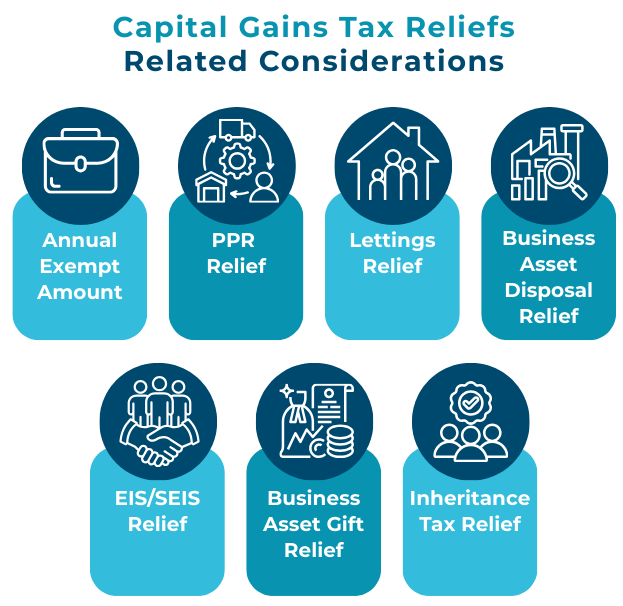
Potential tax reliefs, such as private residence relief and annual exempt amounts, may be available to reduce your CGT liabilities significantly. It is crucial to consult with a qualified accountant specialising in capital gains tax to accurately calculate your liabilities and explore potential tax-saving opportunities. Here are some potential reliefs that individuals may be eligible for:
Annual Exempt Amount
- Every UK taxpayer receives an annual tax-free CGT allowance
- This amount is subject to change each tax year, so check HMRC’s latest figures
Principal Private Residence Relief (PPR)
- Applies to the sale of your main home, potentially exempting you from CGT
- Must have lived in the property as your main residence
Lettings Relief
- Available if the property was once your main residence and later rented out
- Since April 2020, only applies if you shared occupancy with the tenant
Business Asset Disposal Relief (formerly Entrepreneurs Relief)
- Reduces Capital Gains Tax on qualifying business asset disposals, although the rate is increasing – the CGT rate rose from 10% to 14% and is set to increase further to 18% from 6 April 2026
- Commonly used for shares in a trading company, up to a lifetime limit
Enterprise Investment Scheme (EIS) and Seed Enterprise Investment Scheme (SEIS)
- Offer income tax relief when investing in eligible early-stage businesses
- Can defer or reduce CGT depending on the scheme structure
Business Asset Gift Relief
- If you give away a qualifying business asset, CGT can be deferred
- The tax becomes payable when the recipient disposes of the asset
Rollover Relief
- Allows you to defer Capital Gains Tax when you sell a qualifying business asset and reinvest the proceeds into another qualifying asset
- The gain is rolled into the cost of the new asset and only becomes payable when that asset is eventually disposed of
Holdover Relief
- Enables CGT to be deferred when certain assets are gifted or sold at undervalue, commonly used for business or agricultural assets
- The gain is transferred to the recipient and becomes payable when they later dispose of the asset
Inheritance Tax Relief (related consideration)
- Some business and agricultural assets may qualify for IHT relief
- This can help reduce or avoid CGT for beneficiaries
Please note that tax rules and regulations are subject to change, so it’s essential to consult with a qualified tax advisor or refer to the HM Revenue and Customs (HMRC) website for the most up-to-date information and guidance based on your specific circumstances.
Read our blog to find out more about declaring Capital Gains Tax on the sale of a residential property.
Capital Gains FAQs
How does CGT work if I’m a non-UK resident?
Since April 2015, non-UK residents are liable for Capital Gains Tax on UK residential property. From April 2019, this also includes commercial property and indirect disposals (e.g., shares in property-rich companies). You must report and pay the tax within 60 days of the sale’s completion, even if no tax is due. Double taxation agreements may also affect your liability.
Can I transfer property to a spouse to reduce Capital Gains Tax?
Yes. Transfers between married couples or civil partners are not subject to CGT, and the receiving partner inherits the original base cost. This strategy can be useful to use both partners’ annual CGT allowances and potentially reduce the tax bill if one spouse is in a lower tax band. However, it must be done carefully to ensure full compliance with HMRC rules.
Strategic Tax Planning and Optimisation
With Capital Gains Tax rates ranging from 10% to 24%, and various allowances and reliefs available, seeking professional advice is essential. By proactively implementing effective pre-transaction plans, you can minimise, defer, or potentially eliminate the tax burden associated with disposing of an asset, while maximising the benefits of available relief.
A skilled property tax advisor can play a pivotal role in helping you develop effective tax planning strategies. They can review your portfolio of assets, assess potential tax liabilities, and advise on the optimal timing and structure of property sales to minimise your overall tax burden.
For instance, if you plan to sell multiple properties over time, a qualified accountant can help you strategise the order of sales to take advantage of annual exempt amounts and lower tax rates. They can also provide guidance on tax-efficient ownership structures, such as trusts or limited companies, which may offer benefits depending on your individual circumstances.
Looking for Property investor accountants? What does a property account do? Read our blog to find out more.
Passman Leonard are experts in Capital Gains Tax Advice
Navigating the intricacies of CGT requires a deep understanding of the tax rules and regulations. It’s a complex area with various rules, caveats, and exemptions, so utilising a specialist capital gains tax accountants is worthwhile and can save you money and hassle in the long term.
Our chartered and certified accountants have undergone rigorous training and possess in-depth knowledge of tax laws and regulations. Our expertise ensures that you receive accurate advice, stay compliant with tax obligations, and optimise your financial outcomes.
We can assist with the preparation and submission of your self-assessment tax return, ensuring all relevant details are included and calculations are accurate. Our attention to detail reduces the risk of errors or omissions that could lead to penalties or inquiries from tax authorities.
Looking for capital gains tax accountants to help you keep more or your profit? Get in touch today via email info@passmanleonard.co.uk or call on 01895 434515.
Written by: Puja Shah, Director – FCCA, CTA
Author Bio: Puja is a partner at Passman Leonard and a specialist tax advisor with extensive experience in resolving HMRC investigations and complex tax queries. Her deep knowledge of tax regulations, reliefs, and allowances enables her to deliver strategic advice that supports clients’ financial growth and minimises tax liabilities.


